Configure the support perimeter
Platform Support Settings gives platform operators a dashboard panel to manage their support configuration within the Stripe ecosystem.
Context-Aware AI Support System For Multi-Party Ecosystems
A context-aware AI support system that unravels multi-party complexity by diagnosing exactly what is happening and who owns the problem before safely executing a resolution.
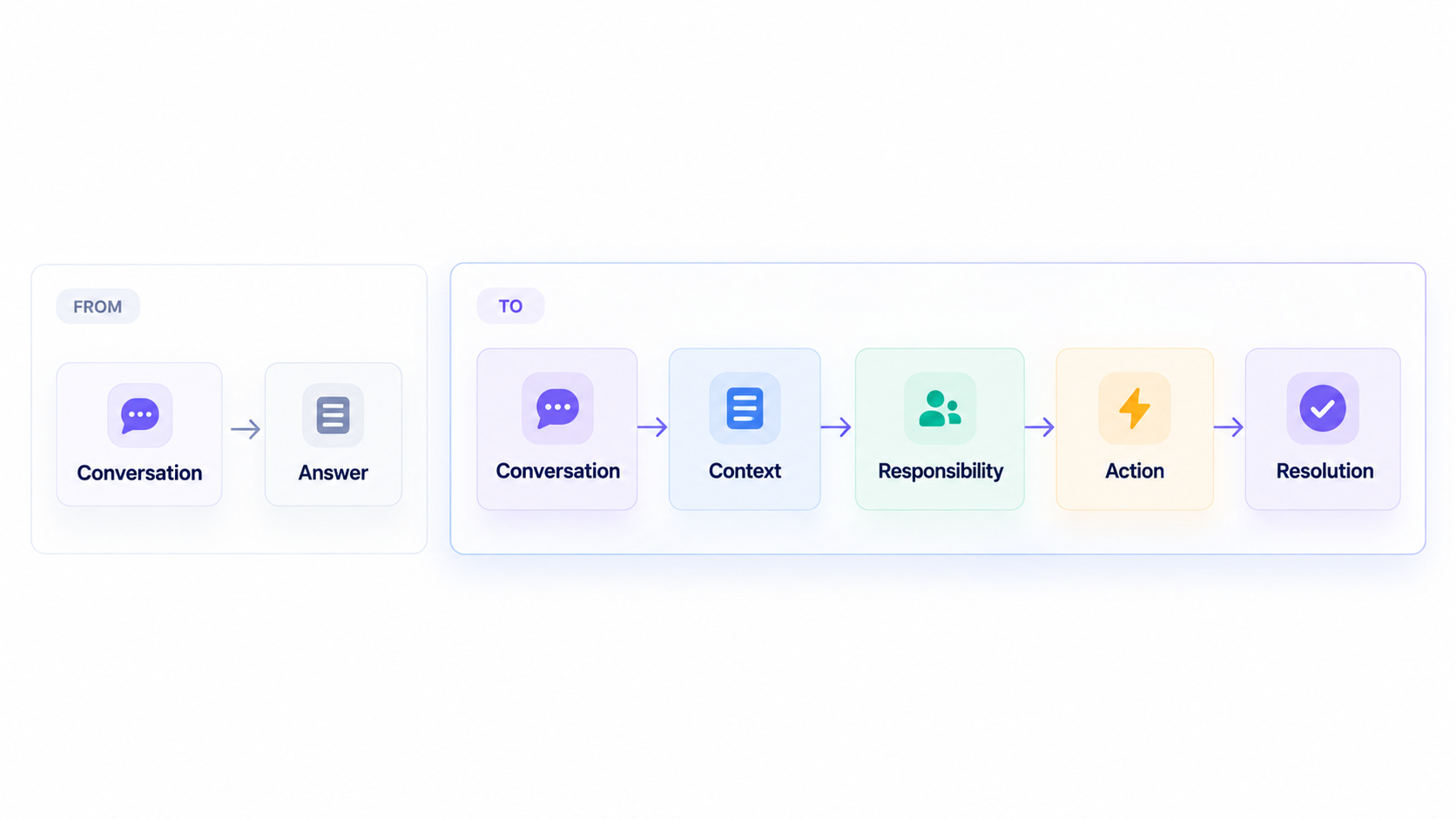
01. THE CORE INSIGHT & PRODUCT HYPOTHESIS
Stripe Connect introduces a multi-party support challenge that is fundamentally different from traditional B2C customer service. A single issue such as a delayed payout can involve a platform (e.g., Shopify), a connected account, Stripe's risk engine, or all three.
The core problem is not: “What is the correct answer to the user’s question?”
The core problem is: “What is the system state, who owns the problem, and what action is required?”
I propose treating support resolution as a context and decision problem, not just a conversational AI problem. Instead of allowing the LLM to infer logic from the user’s text alone, we must create a structured resolution layer between the conversation and the final action.
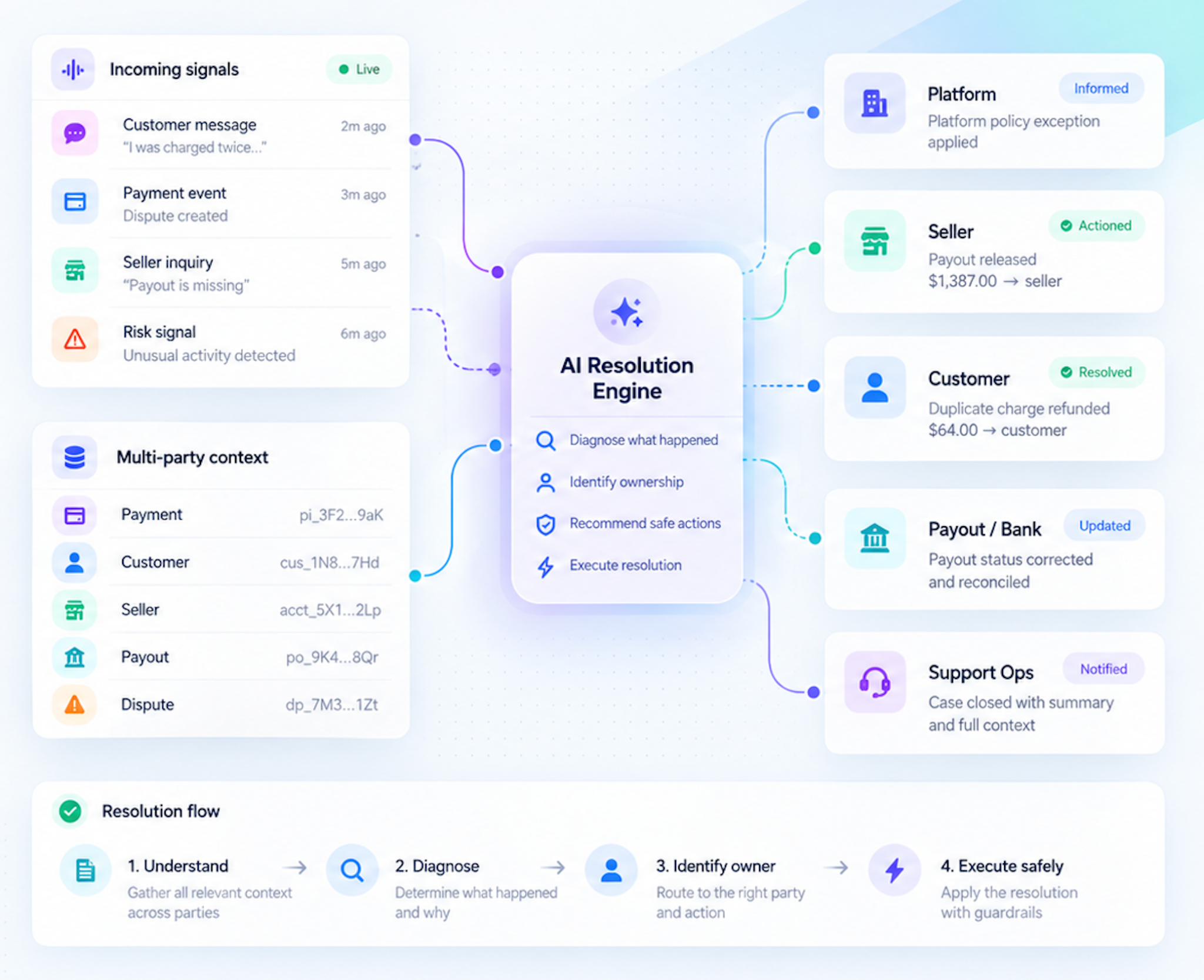
02. EVIDENCE OF THE PROBLEM
User feedback across forums (Reddit, Trustpilot, internal tickets) highlights severe friction caused by context-blind AI routing:
“My funds are on hold. The Platform says ‘Talk to Stripe’. Stripe AI says ‘You are a Custom Account, talk to your platform.’ Nobody takes ownership.”
“I have a Standard account for an old project and a new Express account for Kickstarter under the same email. The AI keeps giving me instructions for the wrong dashboard.”
A fluent AI response is a failure if it lacks the architectural awareness of the user’s exact relationship with Stripe and their Platform.
03. THE RESOLUTION ENGINE (SYSTEM ARCHITECTURE)
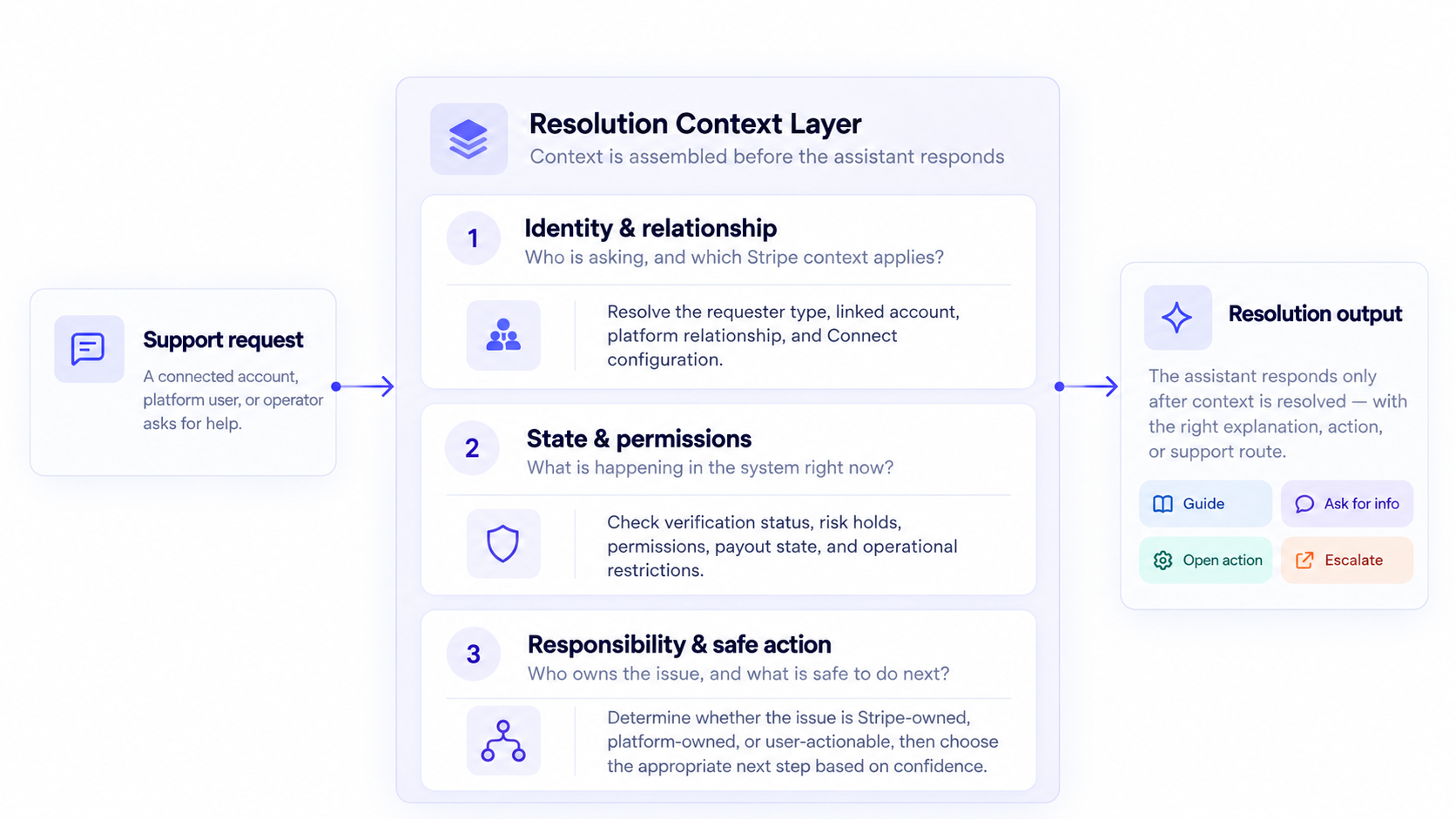
For every support request, the system builds a deterministic Resolution Context before generating a single word. We inject structured system data directly into the AI’s prompt:
1. IDENTITY & RELATIONSHIP
Aggregates data via API: Is this an end customer, a Standard account, or a Platform operator? What is the Connect configuration?
2. STATE & PERMISSIONS
Checks real-time flags: Are there active risk holds, KYC verification gaps, or platform-level operational restrictions?
04. THE UX LAYER: DESIGNING FOR ACTION
The AI interface must evolve from an open-ended “chat box” into a dynamic, state-aware workspace. We shift from AI as an assistant to AI as an orchestrator.
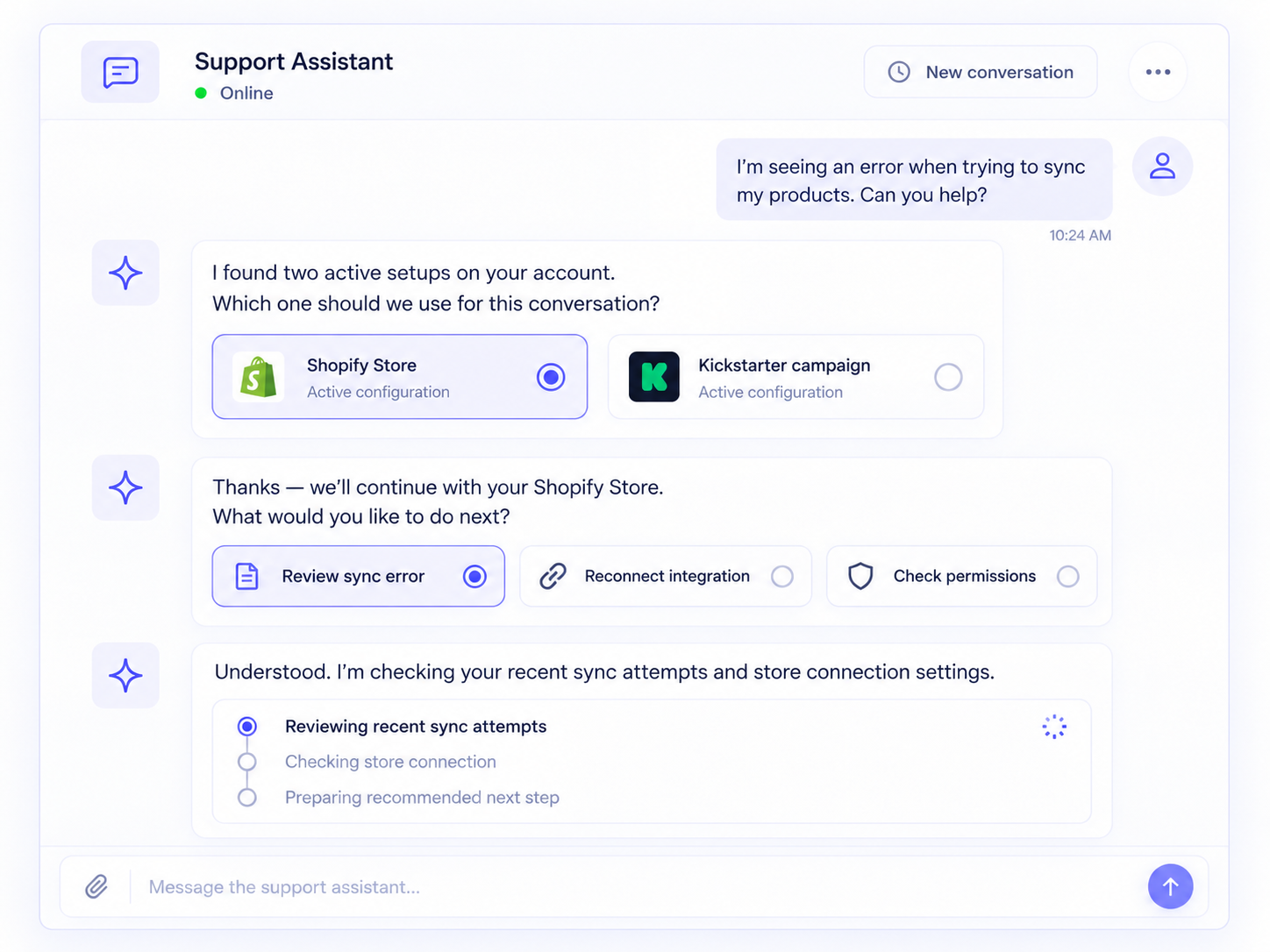
A. PROACTIVE DISAMBIGUATION
If the Context Engine detects a 1-to-many relationship (multiple accounts under one email), the AI refuses to answer the query until the scope is explicitly locked via UI.
UX OUTPUT
“I see you have two active configurations: a Shopify Store and a Kickstarter campaign. Which account are we troubleshooting today?” [User clicks a UI Chip to lock context]
B. SMART HANDOFFS (THE ANTI-PING-PONG PROTOCOL)
When an issue is Platform-owned, the AI does not just send the user away. It acts as a mediator.
UX OUTPUT
“Your payout schedule is fully managed by Shopify. To fast-track this for you, I’ve generated a diagnostic token #STR-892. Please provide this to Shopify Support so they can instantly see your Stripe backend state without asking you technical questions.”
C. EXPLICIT COMPONENT RENDERING
If the AI identifies a blocker (e.g., missing KYC), it bypasses textual explanation and invokes a front-end component directly inside the chat flow.
UX OUTPUT
“Your recent transactions triggered a standard security review. Please upload your last 3 supplier invoices below to release the hold.” [Renders secure file upload widget inline]
05. PLATFORM ENABLEMENT (B2B2B)
Stripe Connect support needs to reflect both Stripe’s system state and the platform’s own policies. Platforms need a way to define that context so connected accounts receive guidance that applies to their actual setup.
Platform Support Settings gives platform operators a dashboard panel to manage their support configuration within the Stripe ecosystem.
Custom Prompt Injection lets platforms provide business rules, such as refund timelines and links to their own support portal.
When a connected account asks for help, retrieval-augmented generation (RAG) combines Stripe’s technical information with the platform’s supplied business context to guide the response.
06. DESIGNING FOR AI FAILURE (CONFIDENCE LEVELS)
Because this system operates inside financial infrastructure, confidence must govern behavior.
System has verified the context, matching rules, and user intent. Action: Execute autonomous resolution (e.g., guide through integration, explain specific fees).
Intent is clear, but state data is complex. Action: Provide contextual guidance but avoid irreversible API actions or definitive account decisions.
System lacks evidence or detects high-risk fraud triggers. Action: Escalate immediately. Assemble the “Resolution Context” payload and hand off to a Human Risk Agent so they start with full visibility, not a blank slate.
07. EVALUATION & PRODUCT METRICS
A polite, fluent AI that routes a user to the wrong party is a failure.
| METRIC | DESCRIPTION | GOAL |
|---|---|---|
| Ownership Accuracy | Did the AI correctly identify if the issue belongs to Stripe, the Platform, or the User? | Primary LLM Eval |
| Autonomous Resolution Rate | Cases fully solved or handed off to platforms without Stripe human intervention. | Increase |
| Wrong-Routing Rate | Instances where a user was sent to the platform, but the platform had to send them back to Stripe. | Minimize (< 2%) |
| Escalation Precision | Did the AI escalate to humans only when context was actually low-confidence or high-risk? | Optimize |
| Time-to-Context | Time saved by human agents reviewing the AI’s pre-compiled “Diagnosis State” payload. | Decrease |
CLOSING PRINCIPLE
My proposal builds a verified account context, identifies the responsible party, and uses confidence to guide the next step. When the system cannot establish a reliable path, it passes that context to a human agent rather than forcing an answer.
FROM
Conversation → Answer
TO
Conversation → Context → Responsibility → Action → Resolution