Driver Context
Capture vehicle needs, route preferences, desired facilities and assistance settings before departure, using defaults when the driver skips setup.
Designing navigation around the driver, not just the destination.
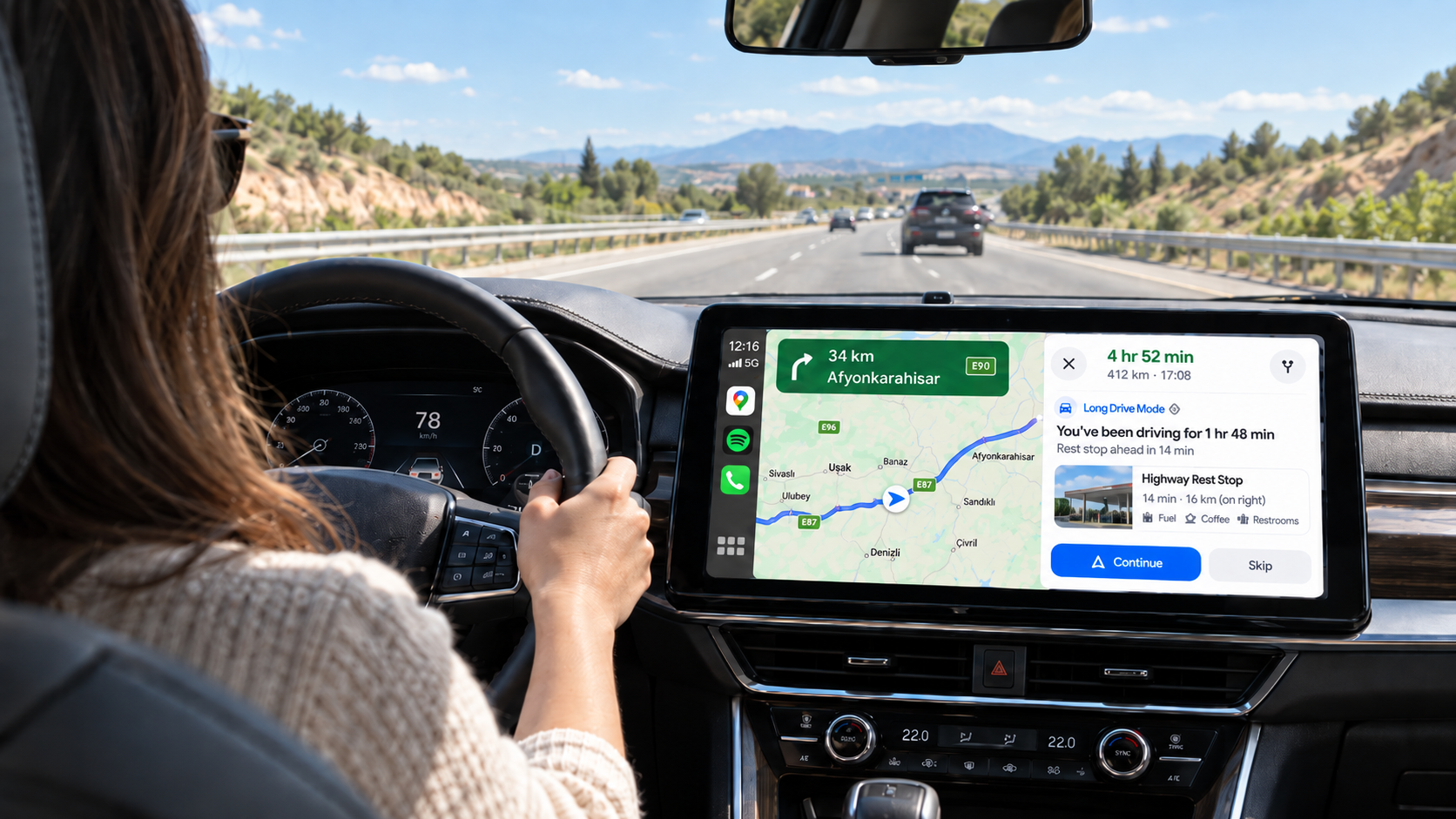
Long Drive Mode is a concept for Google Maps that helps people plan, manage and adapt long-distance drives with fewer decisions and less interaction while on the road. When you're several hours into a drive, the moment when you most need help is also the moment when you should be interacting with your phone the least.
THE PROBLEM
On long drives, following a route is only part of the task: drivers also have to decide when to take a break and which stops fit their needs without adding unnecessary detours.
Google Maps already answers one question extremely well: “How do I get there?” But long-distance driving produces a different set of problems ones that become most difficult precisely when the driver should be focused on the road, not the phone.
A driver hours into a highway journey may need to decide: when to stop, where they can stop without a large detour, whether a petrol station is even on their side of the road, and whether they can combine fuel, food and a restroom into a single stop. None of these are answered by a route.
“Google Maps knows where you’re going. What if it also understood what you’ll need along the way?”
PRODUCT HYPOTHESIS
Long Drive Mode captures vehicle type, stopping needs, route preferences and preferred timing before departure, helping Maps anticipate relevant stops rather than requiring drivers to search while driving. My hypothesis: planning ahead and surfacing only timely, useful suggestions could reduce manual interactions and last-minute decisions, making long journeys more efficient and less stressful without adding new distractions.
THE EXPERIENCE
The following walks through how Long Drive Mode shapes a single drive before it begins, during it, and in how the system stays in control without demanding attention.
01 / BEFORE & DURING THE DRIVE
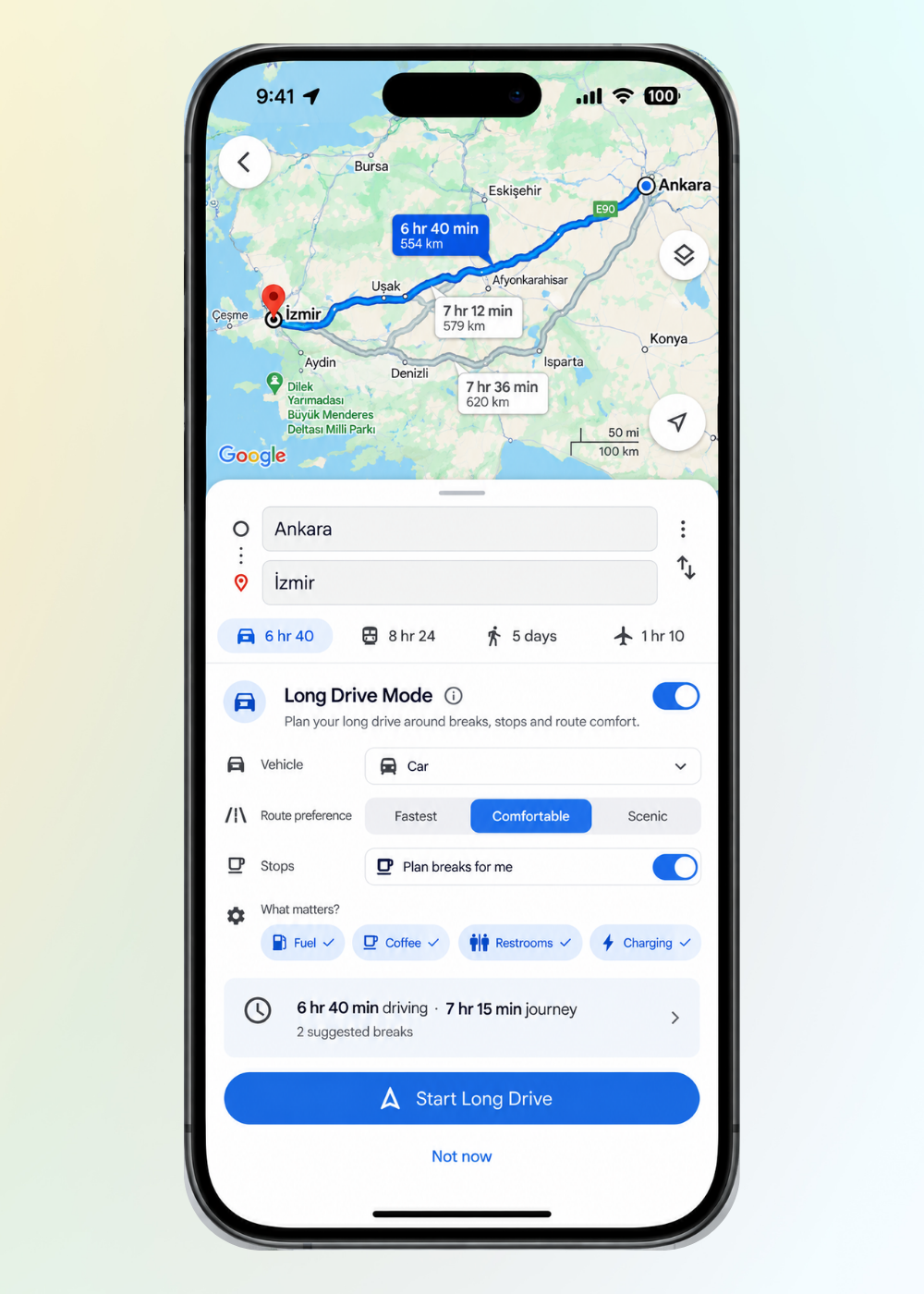
Long Drive Mode starts understanding the driver’s needs before the journey begins. Vehicle type, route preferences, break strategy and journey needs help Maps build a plan around the driver, including suitable stops and a realistic estimate of the whole trip.
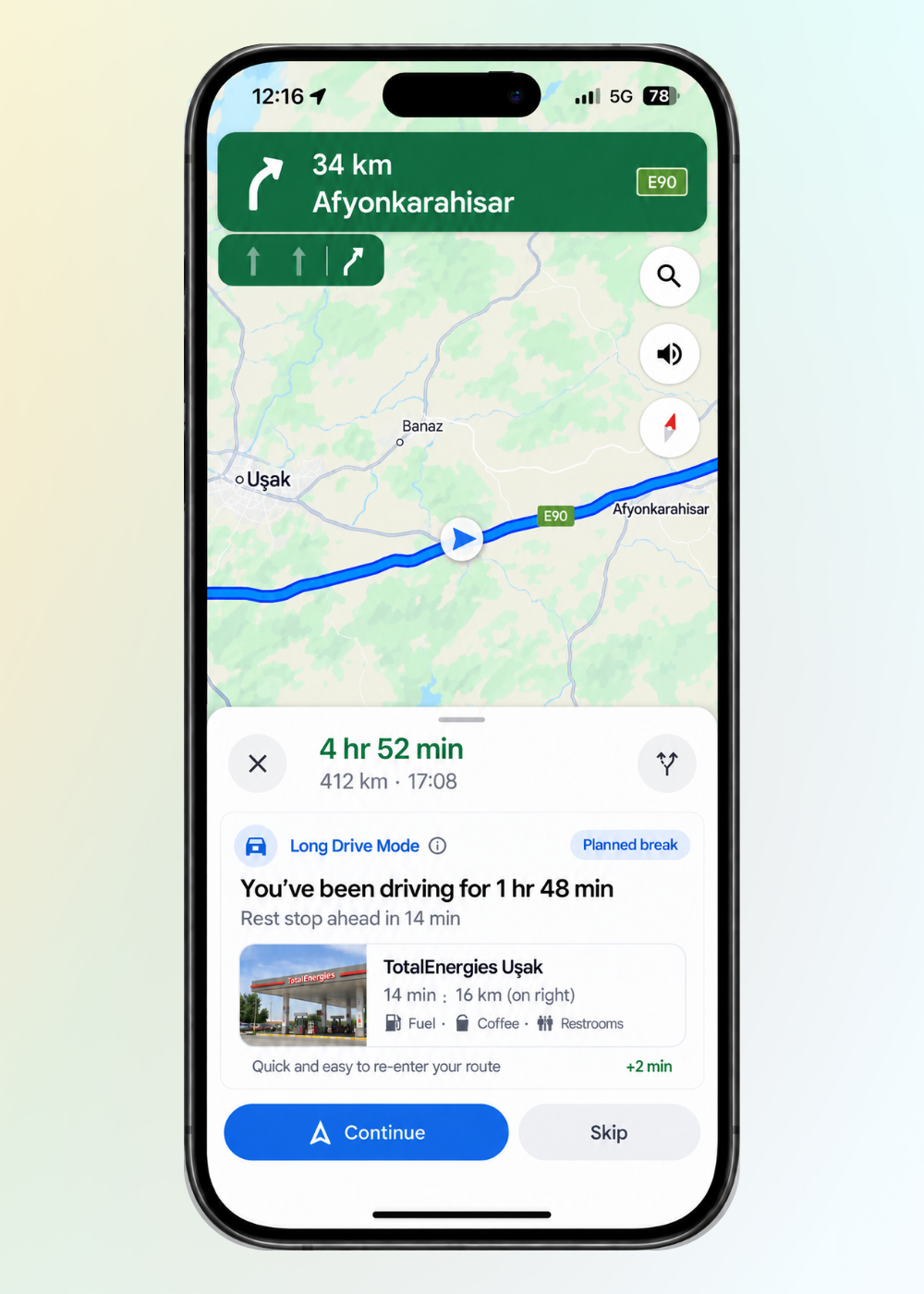
That context carries into the drive. Maps can surface relevant stops and upcoming breaks before the driver needs to search, adapting recommendations as the journey unfolds. Planning ahead and anticipating needs on the road work together to reduce decisions and unnecessary phone interaction.
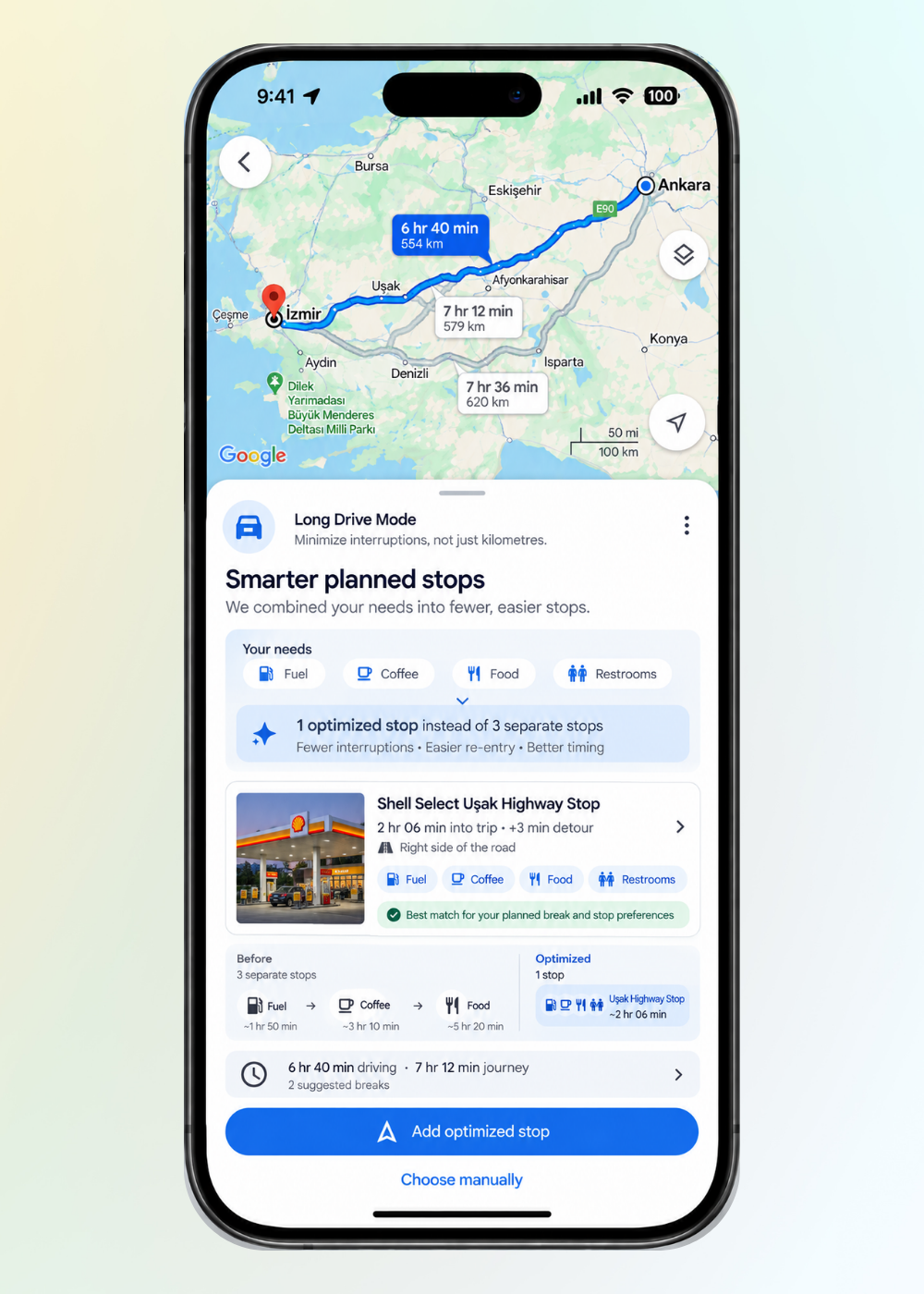
Maps can then build a journey plan rather than only calculate driving time. Instead of showing 6 hr 40 min, the driver sees a realistic forecast including two planned breaks, their estimated impact, and what is available at each stop.
Driving time tells how long the road takes. Journey time tells what the trip will actually require.
02 / PERSONALIZATION
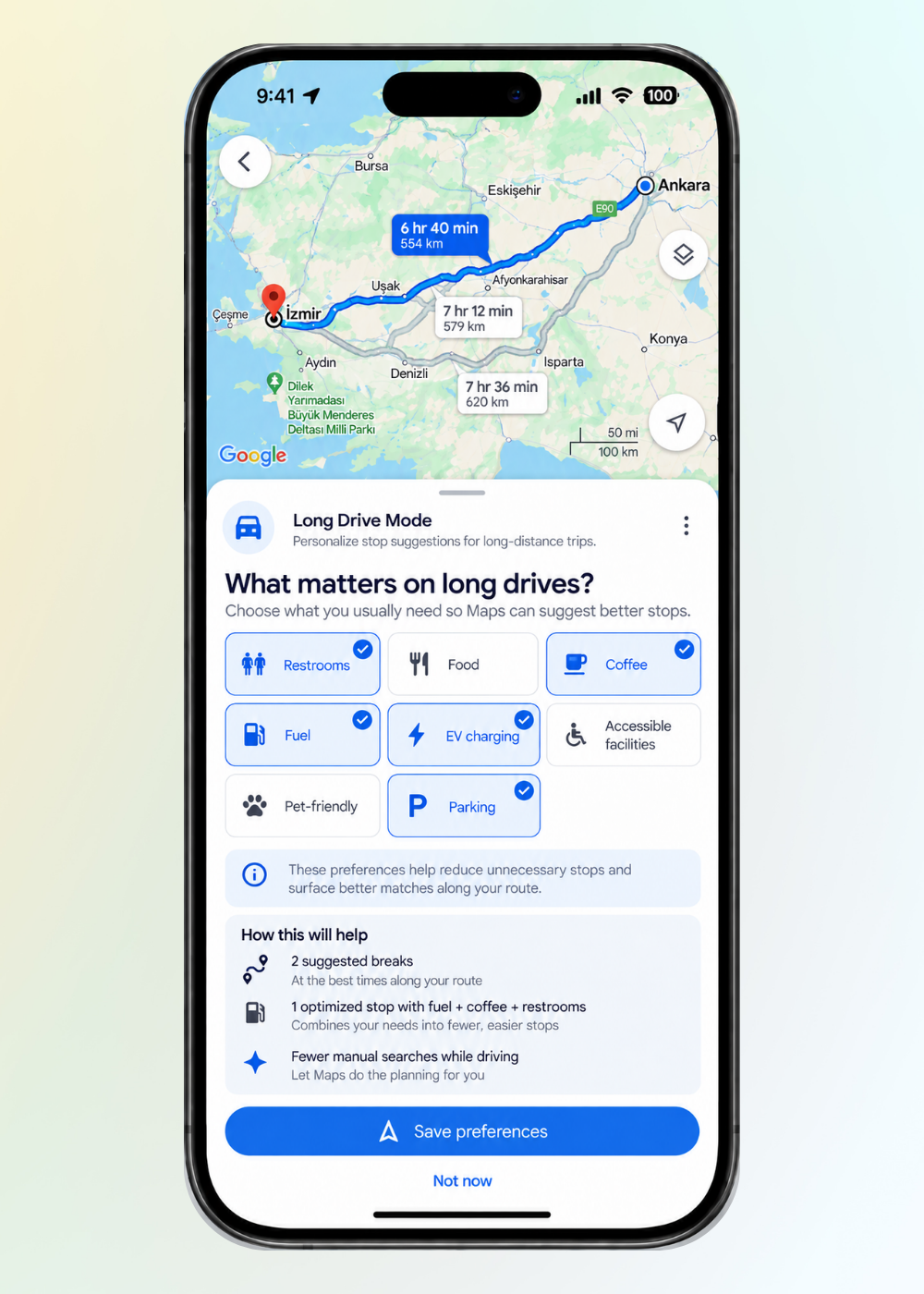
A good stop is contextual. Instead of repeatedly configuring every journey, Maps asks once: What matters to you on long drives?
These preferences then shape stop recommendations, journey planning, search results along the route, and proactive suggestions without requiring configuration at the start of every trip.
Personalization should never become a prerequisite for navigation. The experience must still work for a driver who wants to leave immediately.
03 / ROUTE & STOP COMFORT
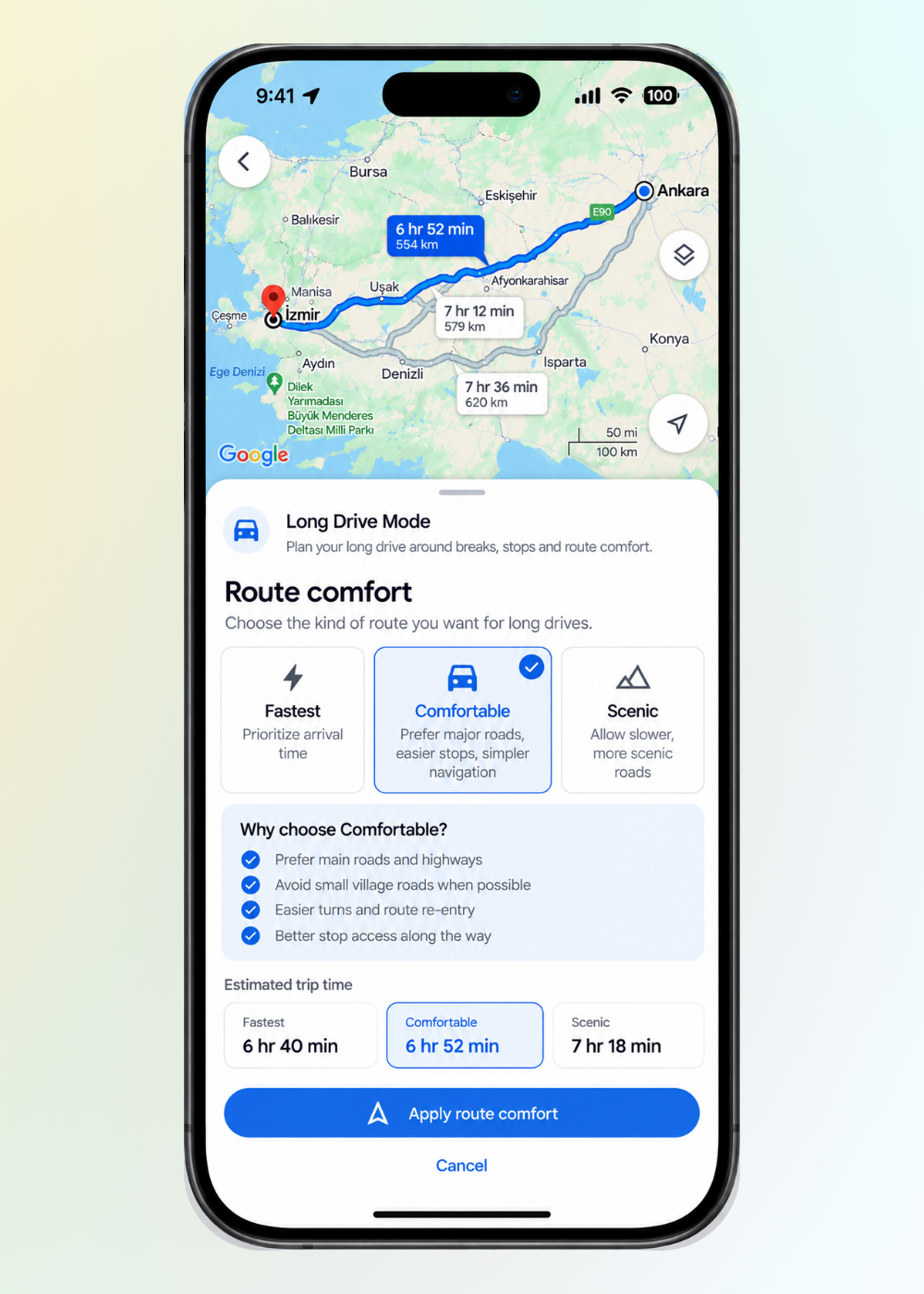
The fastest route and the nearest stop do not always make for the easiest journey. Long Drive Mode captures the driver’s preferences before departure, then considers road conditions, difficult turns, available services and stop accessibility together. It recommends routes that match the driver’s comfort preferences and stops that are easy to enter and rejoin from their direction of travel reducing avoidable detours, fatigue and stress along the way.
Advanced users can refine route comfort by choosing to avoid narrow or unpaved roads, minimize difficult turns, and prioritize well-serviced roads.
For stops, Maps prioritizes highway service areas that are easy to enter and rejoin from the driver’s direction of travel. A recommended stop can combine fuel, coffee and restrooms in one location, reducing detours and unnecessary stops.
04 / SMARTER PLANNED STOPS
Finding fuel, food, coffee and restrooms at the same stop can be difficult. Stopping at multiple locations adds travel time and stress, so Long Drive Mode prioritizes service areas that bring these needs together in one place.
“Minimize interruptions, not just kilometres.”
Instead of optimizing each stop independently, Long Drive Mode optimizes the stop sequence. When the driver selects their preferred fuel provider, coffee preference and break rhythm, Maps finds service areas where a single stop covers all three.
05 / PROACTIVE ASSISTANCE
Driver distraction is a safety risk. Every unnecessary alert can pull attention away from the road, so preventing avoidable interruptions is a core product requirement.
SYSTEM THINKING
Long Drive Mode should not behave like a collection of disconnected features. Each recommendation comes from the same underlying evaluation model applied consistently to every possible stop along the route.
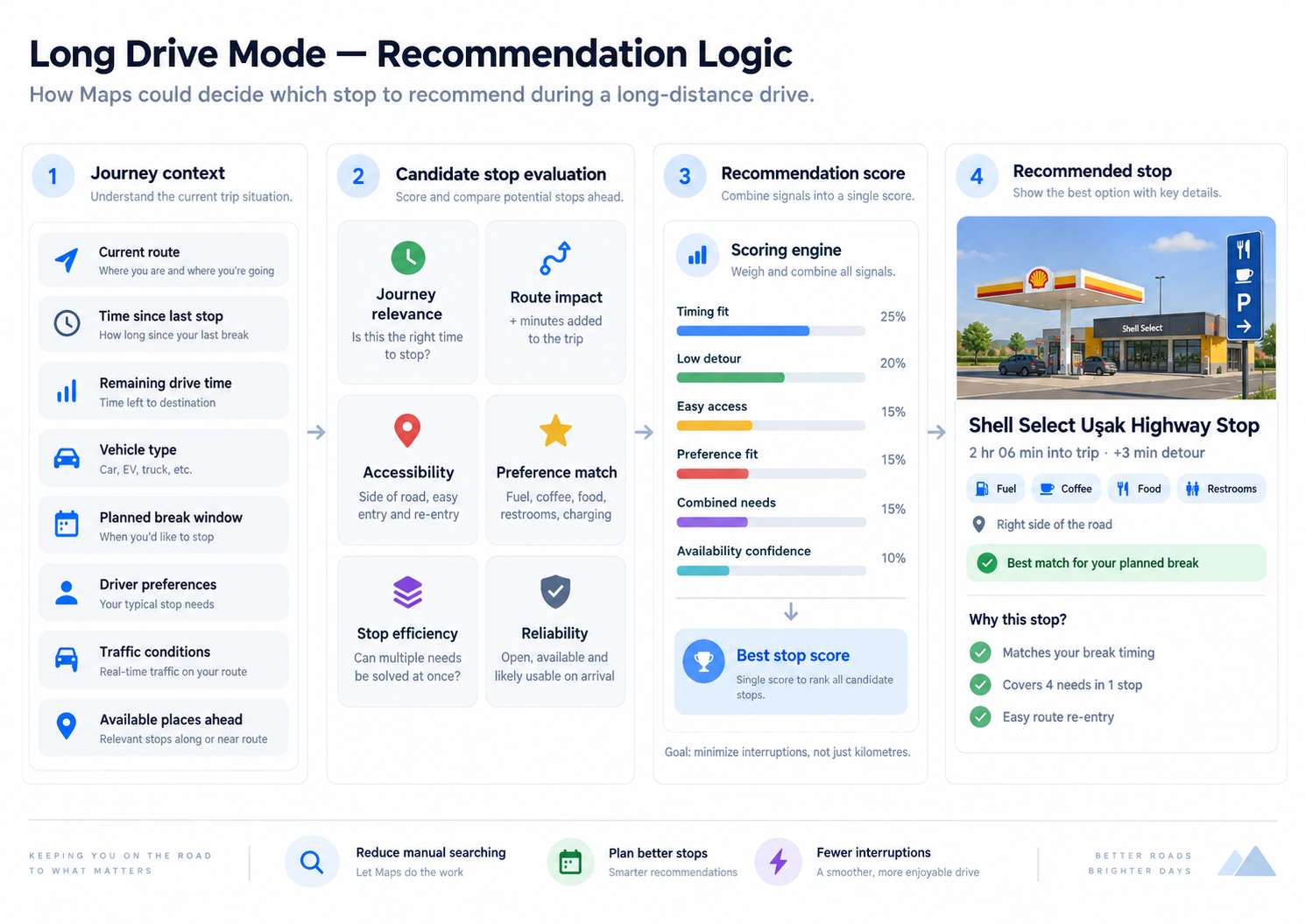
Capture vehicle needs, route preferences, desired facilities and assistance settings before departure, using defaults when the driver skips setup.
Turn the route into a journey plan with suitable break points, available services and estimated stop durations.
Filter out stops that do not meet essential requirements, including opening hours, vehicle compatibility and access from the direction of travel.
Compare eligible stops by preference fit, route effort and how many needs they can meet in a single visit.
Use driving progress and the selected assistance level to decide whether a recommendation is useful enough to surface now.
Update the plan when a stop is skipped, conditions change or new information becomes available, while keeping the driver in control.
These signals produce a recommended stop, rather than simply showing the nearest location.
PRODUCT STRATEGY
The concept could expand into a broad driving assistant, but that would weaken the initial product hypothesis. The MVP focuses on one clear problem: reduce unnecessary decisions and interactions during long-distance driving.
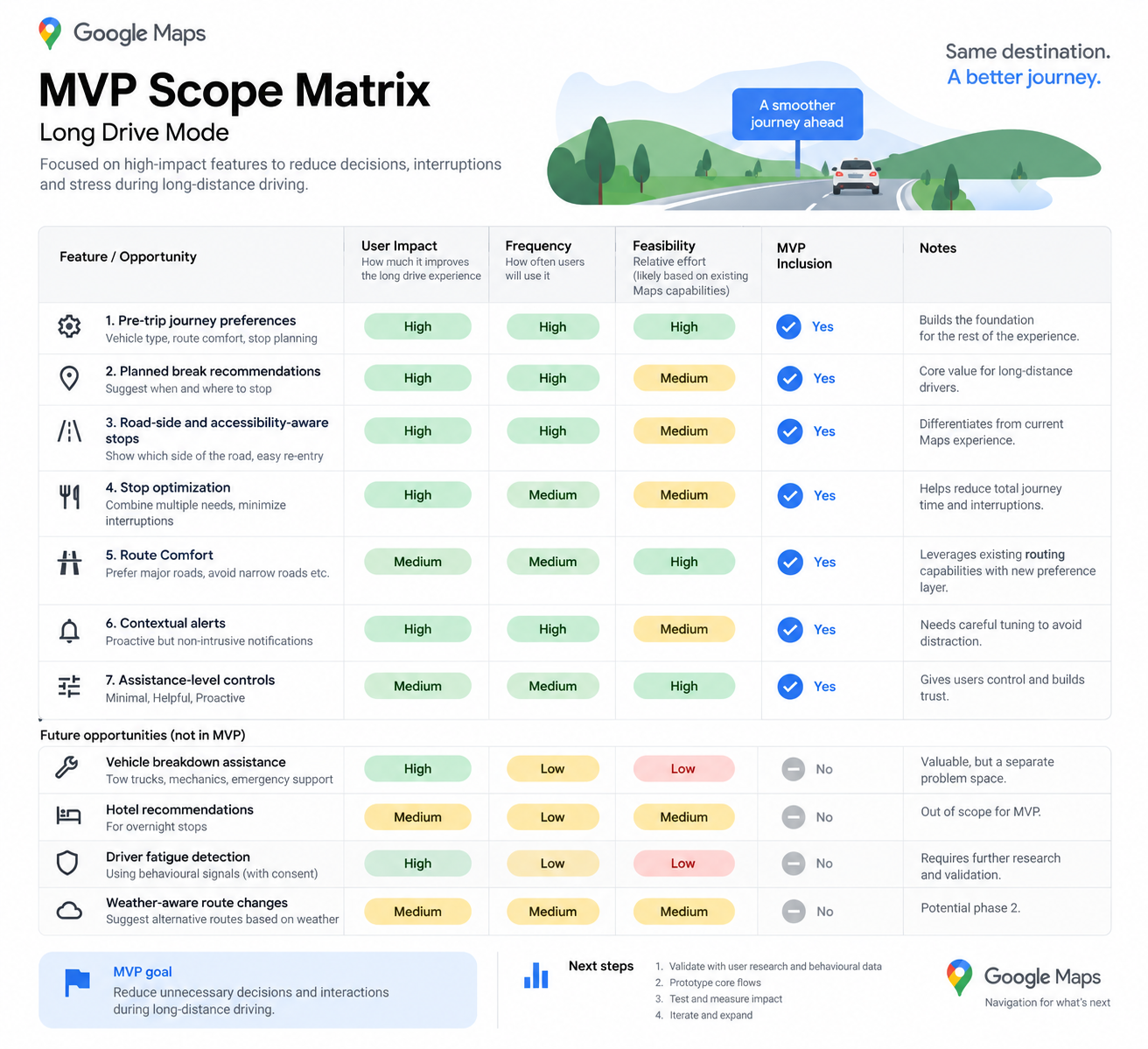
Vehicle breakdown assistance · Tow truck & mechanic discovery · Hotel recommendations · Weather-aware route changes · Advanced fatigue detection · Emergency support
These solve related but distinct problems. Including them in the first release would turn the concept into a generic driving assistant and dilute the core hypothesis.
DESICION LOG
| DECISION | WHY |
|---|---|
| Proactive assistance over another search surface | The main friction occurs when searching is least appropriate when the driver is in motion at speed. |
| Journey friction over proximity | The closest stop is not always the easiest stop. Scoring accessibility reduces bad recommendations. |
| Combine needs into fewer stops | Every additional stop creates another interruption, deceleration and re-entry overhead. |
| Optional personalization | Setup cannot become a prerequisite for navigation. The feature must work for immediate departures. |
| Limit proactive behaviour | Assistance that constantly interrupts contradicts the product goal of reducing interaction. |
| Emergency assistance outside MVP | It solves a different job and would expand the scope prematurely before the core hypothesis is validated. |
MEASUREMENT
If I were developing Long Drive Mode at Google, this is how I would evaluate and measure it.
To accurately assess the success of Long Drive Mode, measurement must rely on standard, retrievable navigation telemetry rather than theoretical edge cases. The primary objective is to validate whether the feature successfully reduces driver cognitive load while providing sustained value during extended trips.
The percentage of eligible long-distance routing sessions (e.g., trips exceeding 2 hours) where users actively opt into Long Drive Mode.
The percentage of users who activate the feature again on their subsequent long-distance trips. High repeat usage is the strongest behavioral indicator of genuine product value.
The average number of manual screen taps or active search queries per 100 miles, compared against a control group using standard navigation. A successful feature will show a definitive decrease in manual inputs, proving the interface requires less active management.
The percentage of users who complete their entire journey in Long Drive Mode without manually aborting or reverting to the standard Google Maps interface mid-trip.
The rate at which drivers accept and navigate to proactively surfaced pit stops (fuel, EV charging, rest areas) without having to initiate a manual search.
How frequently users accept proactive rerouting suggestions designed to avoid high-stress driving conditions (e.g., complex junctions, unpaved roads) surfaced by the system.
RISKS & VALIDATION
If I were a Product Manager at Google, this is how I would evaluate, validate, and de-risk the Long Drive Mode experience prior to rollout. My core focus would be proving that our proactive recommendations genuinely reduce cognitive load without increasing driver distraction or eroding system trust.
The exact threshold where helpful assistance turns into an irritating or dangerous distraction.
The alert dismissal rate, the average time taken to interact with a prompt, and UX lab eye-tracking metrics to ensure off-road glances remain safely brief.
Whether an algorithmically "convenient" stop (e.g., shortest detour) aligns with what a fatigued driver actually considers a safe and comfortable place to rest.
The suggested-stop acceptance rate versus the frequency of manual POI (Point of Interest) searches used to override our recommendations.
Our system's ability to confidently surface accurate, real-time operating hours and amenity data (e.g., EV charging availability) in remote or rural areas.
The volume of "Place was closed/inaccurate" user reports and the rate of immediate mid-route reroutes after reaching a suggested destination.
Whether deep personalization restricts the algorithm so much that it fails to find suitable stops during long stretches of highway.
The frequency of "zero results found" fallback states and the rate at which users manually loosen their filter criteria mid-drive.
The amount of pre-drive friction users will tolerate to configure their preferences before abandoning the feature entirely.
Funnel drop-off rates during the initial setup flow, time-to-start-navigation, and the percentage of users who stick to default settings versus custom configurations.
That the interface feels supportive rather than prescriptive, ensuring drivers do not feel judged or "nagged" about their driving fitness.
Feature disablement rates following proactive alerts, and qualitative A/B test results comparing suggestive copy against directive copy.
FINAL THOUGHTS
Navigation shouldn't end when the drive begins. Long Drive Mode evolves Google Maps from static route calculation to active journey management, handling complex road decisions so the driver doesn't have to.
FROM
Route → Navigate → Arrive
TO
Understand → Plan → Anticipate → Adapt → Arrive